
The Essentials
- Safety Critical Elements (SCEs) are systems, equipment, or devices whose failure can cause or worsen an accident event, making their reliability essential to industrial risk management.
- Effective SCE reliability management involves identifying major accident hazards, defining performance standards, prioritizing maintenance, monitoring equipment health, forecasting failures, and continuously improving safeguards.
- During investigations, forensic analysis compares expected and observed performance of an SCE to identify functional gaps, failure modes, and mechanisms that contributed to the event.
- SCE failures generally result from a missing safeguard, an element that does not meet its required specifications, or degradation that reduces its functionality over time.
- A pilot-plant explosion demonstrates how unrecognized SCEs, inadequate maintenance, and ineffective management of change can contribute to an incident.

Understanding Safety Critical Elements in Risk Management
Managing risk in manufacturing and processing industries (e.g., oil & gas, chemical petrochemical, pharmaceutical) requires proper resource management and safety priorities, including ensuring that systems, equipment, and devices work as needed, when needed.
This is particularly important with elements directly linked to facility risk control, the failure of which can lead to a catastrophic event. These elements are known as Safety Critical Elements (SCEs).
However, despite their importance, many facility maintenance departments treat all equipment equally, without assigning priorities. As a result, high-priority elements (i.e., SCEs) may not be repaired promptly, increasing the probability of a catastrophic event. Therefore, a key challenge in industrial investigations is adequately managing SCEs.
This article addresses this challenge by explaining SCE reliability management and how to analyze SCE failures during incident investigations.
Safety Critical Elements
Safety Critical Elements, or SCEs, are elements that form part of a system and whose failure leads to or contributes to the occurrence of a Major Accident Event (MAE), or to an increase in its severity.[1]
MAEs are defined by the International Labour Office (ILO) as sudden and unexpected events that include a major emission, fire, or explosion resulting from deviations in the course of operation of any industrial activity and leads to serious danger to workers, the public, or the environment, whether immediate or delayed, inside or outside the facility, and involving one or more hazardous substances.[2]
The UK Health and Safety Executive (HSE)[3] further explains that one requirement for an occurrence to be defined as an MAE is that it must result from an event that is out of control. An out of control event occurs when the operator cannot or loses the opportunity or ability to control the situation or condition. Consequently, the definition depends on the control capability available, meaning that the definition of MAE is process specific.
Based on these definitions, the importance of SCEs lies in controlling the risk of major accidents, which have the potential to cause significant losses to both the organization and the community. Therefore, reliability management is critical to ensuring that SCEs do not fail when they are needed most.
To support this demand, a reliability management process should be in place to ensure SCEs are identified, desired performance is defined, and functionality is maintained over time.
This management system is an iterative cycle composed of the following elements:
- MAE identification: Performed through traditional process hazard analysis activities (PHA).
- Detailed MAE analysis: MAEs are analyzed to understand threats, potential consequences, and the protective barriers that control their risk, using techniques such as BowTie analysis.
- SCE identification: Non-human elements, such as physical assets or software, that form part of the critical barriers for these MAEs are recognized as SCEs.
- Registration of SCEs in the maintenance system: SCEs must be classified in the maintenance system, so their priority is clear for maintenance, testing, and inspection activities.
- Development of performance standards: These documents define and specify SCE performance requirements, including the safety function, availability, reliability, and survivability (from a major accident) criteria for the SCE.
- Operational health management: This element includes monitoring tasks, inspections, functional tests, and any other activities needed to maintain the health or functionality of an SCE over time.
- Performance and reliability forecasting: This element uses data collected during operational health activities to anticipate degradation and make decisions before failure occurs.
- Continuous improvement: Like any management system, the process requires continuous improvement that feeds back into the cycle and maintains an up-to-date management performance.
Of these elements, performance and reliability forecasting is one of the most complex, often not considered in practice, and associated with the failure analysis cycle. Frequently, analysis of the failure of an element, system, or device is performed only after the failure occurs.
However, this element indicates that failure analysis should begin before failure occurs, so the organization can anticipate and make decisions that prevent both the failure itself and the possibility of leaving the system unprotected.
As shown in the cycle, analysis of the cause of failure is only one component of the overall process. The cycle is linked to the management system described above through the performance standard.
Once the performance standard has been developed, it should be used as the basis for a proactive failure analysis by identifying the failure modes and mechanisms that degrade the safety function and the defined performance criteria.
This information is used to define a failure model that indicates the probability of SCE failure over time. The model is then used to make integrity decisions, but it must be updated as the Operational Health Management element acquires field performance data.
SCE Failures During Incident Investigations
Incident investigation is one of the process safety management elements established in the Center for Chemical Process Safety (CCPS) Risk Based Process Safety guidance[4]. This element ensures that formal investigations are performed so lessons can be learned and recurrence can be prevented.
There are several approaches to consider during an investigation, not limited to a forensic, or technical, review of failure analysis and a management perspective. During the investigation, forensic and technical analysis usually takes center stage and feeds the rest of the investigation.
Once the circumstances that led to the event are determined, the management or organizational aspect becomes more relevant. The study of SCEs during an investigation is no exception and should be based on forensic failure analysis following the guidance established in NFPA 921[5].
Forensic investigation is based on the scientific method, as described in NFPA 921, and should seek to understand the event context, identify associated hazards, analyze the risk, and determine the SCEs that were present or should have been present. This evaluation then supplies a comparative analysis of SCE performance.
The purpose is to identify the desired performance and compare it with the observed performance to detect functional gaps. Once the functional gaps are known, a failure evaluation is performed to identify the failure mode and failure mechanism. All this information is fed back through an investigative process to understand the context of the failure, which then supports the root cause analysis.
Ultimately, the process seeks feedback into the management system and continuous improvement.
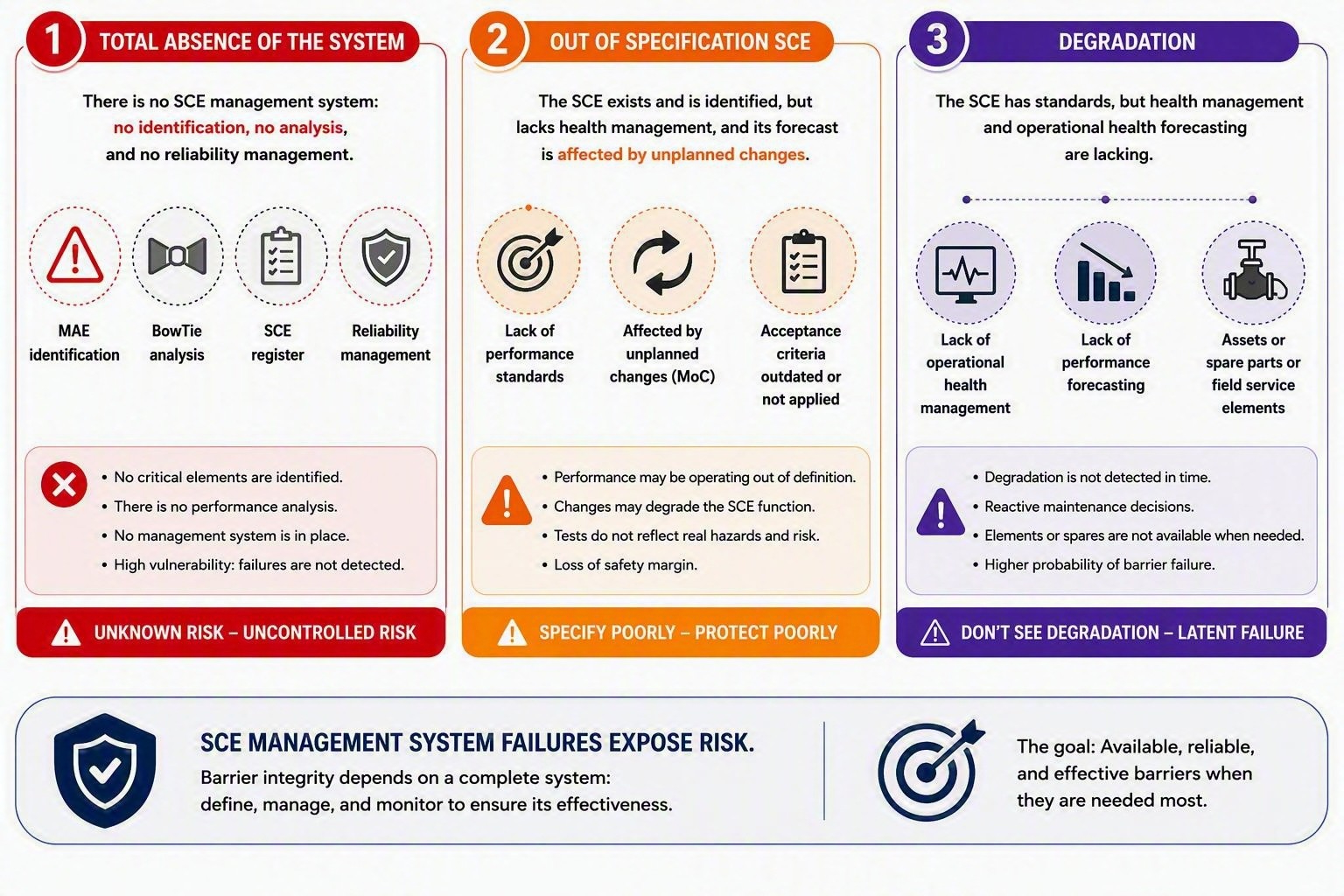
Throughout this process, one of the most frequent questions is where failures or errors are most commonly observed. In general, the observed failures can be organized into three categories.
- Total absence of the SCE, meaning that an SCE should have been implemented but was not present
- The SCE was out of specification, meaning that the design of the element did not meet the required function
- Degraded SCEs were observed, meaning that the SCE may originally have been capable of performing its function, but its functionality decreased over time because of some type of degradation
Figure 4 shows these categories.
Case Study: SCE Failure Analysis
To illustrate how SCE failure analysis is implemented during an incident investigation, the following case study is presented. The case involves an explosion that occurred in a pilot plant.
The pilot plant was located on the first floor of an industrial building. The building had a chemical drainage system for the disposal of chemical substances. Drains from each room discharged into a main line that emptied into a basement tank (e.g., chemical waste detection tank), which discharged chemicals vapors to the atmosphere through a vent.
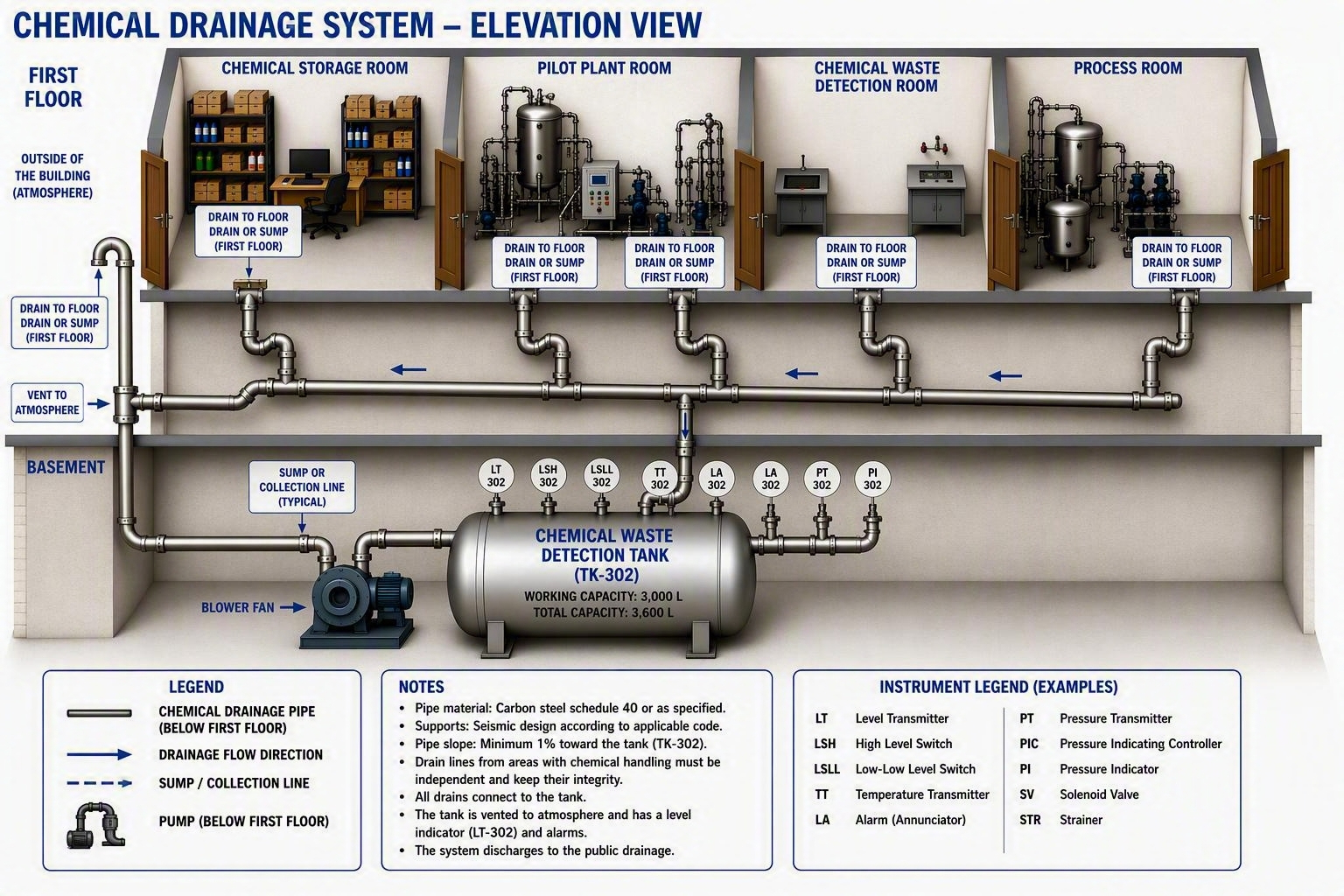
On the day of the event, after a scheduled operation, a considerable quantity of flammable liquid was discharged through the pilot plant drain. A few minutes later, vapor from the drain began to accumulate in the storage room, where it found an ignition source, producing an explosion. The explosion propagated through the corridor into the adjacent rooms.
As part of the investigation, the NFPA 921[6] methodology was followed, confirming that the storage room was the area of origin of the explosion and that no other source of flammable material was present inside the room. With the information obtained through the origin and cause analysis, the SCE evaluation procedure was implemented.
The first step was to identify the relevant SCEs for this event, including those that were present and those that should have been present. This analysis identified the chemical drainage system, ignition control, and explosion venting panels as SCEs. The table below compares the performance of each SCE.
Table 1.
| SCE | Expected performance | Observed performance |
| Chemical drainage system | Vapors directed to the detection tank, preventing accumulation inside the building | Vapors migrated to the storage room |
| Ignition control (classified area) | Ignition sources controlled by ensuring electrical equipment classification | SCE absent |
| Explosion venting relief (NFPA 68) | Explosion pressure is reduced by venting the explosion to a safe location | SCE absent |
Then, the next step establishes the SCE failure modes and mechanisms (Table 2).
Table 2.
| SCE | Expected performance | Observed performance | |
| Performance gaps | Vapor extraction fan was out of service for approximately six months. Loss of vacuum in the tank resulted in loss of extraction function in individual rooms. No maintenance activity existed to keep the goosenecks filled with water. | Room, initially classified as potentially containing ignitable material in design documents, was later declassified | Not identified as a required measure. |
| Failure mode | Sporadic and prolonged shutdown of extraction ventilation. | Absent barrier. | Absent barrier. |
| Failure mechanism | Unknown because of lack of maintenance information. | Failure of implementation and management of change. | Associated hazard was not identified or evaluated. |
To complete the investigation, a Root Cause Analysis (RCA) was performed using the Tripod Beta methodology[7]. An RCA is a formal investigation method to identify and address management system failures that led to an incident; this corrects the underlying reasons (i.e., root causes) that led to the event rather than only the immediate cause.
The analysis showed how root causes contributed to the event, including:
- Failure to identify the drainage system and, in particular, the vapor extraction fan, as SCEs. As a result, there was no failure analysis and no process hazard analysis (PHA) of the drainage system.
- Uncertainty regarding how critical process activities that support the SCE safety function are identified. (i.e., ensuring and verifying water levels are maintained in the drains)
- Failure of the management of change (MOC) system to identify the impact of a change on an SCE, in this case the declassification of a room containing ignitable material.
If the SCE reliability management system had been properly applied, the SCEs needed to control the risk would have been identified from the start. The performance standards required to maintain their safety function and prevent the MAE would then have been established.
How Can ESi’s Process Safety Engineers Help With Risk Management?
ESi’s process safety engineers have extensive experience supporting the implementation and improvement of Safety Critical Element (SCE) reliability management programs across a wide range of industrial operations.
Our consultants help organizations identify and manage process risks, evaluate SCE performance and reliability, and develop practical strategies to maintain the integrity of critical safeguards throughout the asset lifecycle.
Combining expertise in process safety, risk assessment, reliability engineering, and risk-informed decision making, we assist clients in understanding vulnerabilities, prioritizing resources, and strengthening barriers that protect people, assets, the environment, and business continuity.
Whether supporting ongoing operations, capital projects, incident investigations, regulatory compliance efforts, or litigation matters, our team delivers technically sound and actionable solutions tailored to each client's needs.
In addition, ESi’s process safety professionals can leverage ESi's multidisciplinary expertise, including chemistry, chemical engineering, thermal sciences, mechanical engineering, fire and explosion engineering, reliability engineering, biomechanics, and human factors.
This integrated approach enables us to evaluate complex challenges from multiple perspectives and provide comprehensive solutions that enhance safety, reliability, and operational performance.
Sources
- Energy Institute, Guidelines for Management of Safety Critical Elements, Second edition. London: Energy Institute, 2007
- International Labour Office, Prevention of Major Industrial Accidents, An ILO Code of Practice. Geneva: International Labour Office, 1991. Available: https://www.ilo.org/
- Health & Safety Executive, The Control of Major Accident Hazards Regulations 2015: Guidance on Regulations, Third edition. 2015. Available: hse.gov.uk
- Center for Chemical Process Safety, Guidance for Risk Based Process Safety, American Institute of Chemical Engineers (AIChE) and John Wiley & Sons, Inc., 2007
- National Fire Protection Association (NFPA), NFPA 921, Guide for Fire and Explosion Investigations, Quincy, MA, 2024.
- National Fire Protection Association (NFPA), NFPA 921, Guide for Fire and Explosion Investigation, 2023 edition
- The Stichting Tripod Foundation, Tripod Beta: Guidance on Using Tripod Beta in the Investigation and Analysis of Incidents, Accidents and Business Losses, Version 6. Energy Institute, 2023[1] [AJ2]
Back to Insights

